
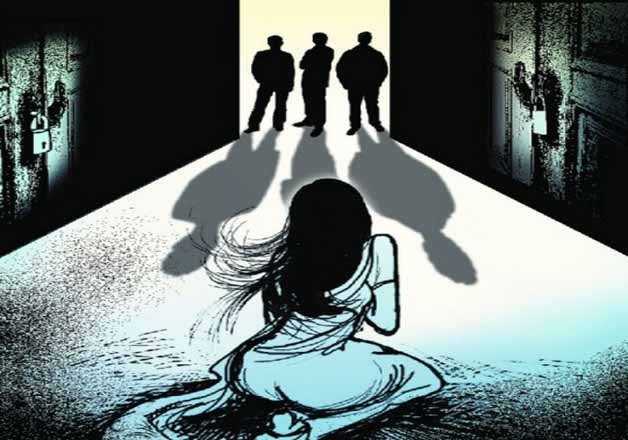
Sitting on a cot on the semi-terrace outside her room, 20-year-old Kiran (name changed) pulls the strings of the jute chaarpai, murmuring in rage. It is anger tempered by the presence of her mother-in-law in the courtyard downstairs. It has been five months since Kiran has gone out to answer nature’s call alone. Women like her are not trusted to be allowed out alone even for that. Kiran was raped by four men repeatedly over four days in different parts of Haryana like Panipat, Sonepat and Kurukshetra before being dumped at the Panipat Railway Station. That was on 28 September 2012. Last month, on 24 April, she was sentenced to a ten-day imprisonment. “The judge, my father, my brother, my husband, my mother-in-law and the biraadari—they are collectively raping my head. Still,” says Kiran.
The month she was raped, 12 more gangrapes were reported. Yet, in many quarters, her case has become a cautionary tale—the risks of a woman, especially one of a ‘lower caste’ landless community, exerting her free will and demanding justice.
In caste terms, Kiran is a Dhanuk.
Banwasa village is in Gohana town of Sonepat district. It is crisscrossed by paddy and vegetable fields. The Dhanuks who live here, like in other North Indian villages, are considered untouchable. Their houses are on the outskirts of the village. Their traditional job was to remove night soil from ‘upper caste’ houses, but they have long switched to working as agricultural hands, basket weavers, midwives and construction labourers. Landless and ostracised, their only sense of security is their biraadari, which acts as a tool of social control and an informal welfare association.
As she talks about the rape for the first time in many months without the fear of being judged, Kiran starts crying.
“Don’t cry, they want to break you down through character assassination,” I tell her. “Can you tell that to my father and my husband?” she says.
+++
On 28 September , Kiran was at her parent’s place in Banwasa, when Sunita, a neighbourhood housewife, gave her a message that her husband Sudeep had come to meet her near a local railway crossing.
“I had told him once that I want to meet him outside the house like they do in Dilwale Dulhaniya le Jayenge. When the boy comes to get the girl? I thought that’s why he had come to meet me,” says Kiran.
As soon as she reached the outskirts of the village, two men of Khandrai village— Sunil and Sanjay—kidnapped her and took her to a rice field on the Gohana-Kakrohi road. They were later joined by Anil of Ahmedpur Majra village and Sarvan of Hadtari village. Two of them pinned her hands down while the third and fourth raped her. “They laughed as they ripped my clothes with a blade and described my body parts to each other. I was a toy they were trying out.”
From the paddy field to a mini-van to the Brahmsarovar in Kurukshetra to a small room next to railway tracks in Panipat, the ordeal continued. “I begged them to let me go.” They didn’t. She was asked to discard her clothes and change into an old salwar kameez. She remembers waking up the fifth day and fleeing.
Kiran registered a case with the Sonepat police. It took over a week to arrest the four rapists and Sunita, who had allegedly helped them.
According to Yashpal Singh, DSP, Gohana, “We registered Kiran’s statement under Section 164. Once a statement is recorded under this section, rape is confirmed. During the interrogation, the rapists confirmed Kiran’s accusations.” A medical examination conducted at Gohana civil hospital also indicated rape.
Over the next three months, however, Kiran was labelled a prostitute, a thief, a serial offender and a Dalit nymphomaniac. Her in-laws threatened to abandon her, the parents wanted to get rid of her.
“They kept saying, ‘Why did you leave the house? Why didn’t you tell your parents [where you were going]?’” she says. When she was 17, Kiran had eloped with a lover. That episode was cited as justification of her rape, as if her past record had called it upon her. “She ran away with a mechanic from a nearby village,” says a relative of hers who does not wish to be identified, “Her brother Gurmeet brought her back and tried to hang her. We intervened and saved her life. She has always been like this.”
Kiran is the second of five children born to a beldar and his daily-wage labourer wife. They share a two-room hut made of corrugated tin and decaying wood, and led a simple life until what happened to Kiran. “We suddenly did not deserve to be talked to because our daughter was raped and she filed a case. She did not know that poor people do not fight cases in courts,” says the mother. The family’s primary source of income is the daily wage of Rs 250 she earns. She also looks after a couple of buffaloes owned by land-owning Jats who have promised her 30 per cent of the proceeds once they are sold.
+++
Pressure on Kiran’s family and in-laws started mounting as soon as the four men were arrested. “We had anyway started losing days of work: to submit papers in court, to get medical reports, to visit the police station, to attend the court hearings,” says the father.
Various biraadari panchayats from Attadi, Ahmedpur Majra, Hadtari and Banwasa, the five villages the accused belonged to, came together to forge a decision on the matter. The arrest of Sunita, the woman who Kiran says misled her into the paddy field trap, was considered an attack on the pride of the village. “They said that since Kiran is now Ikdaana village’s daughter-in-law, it is Sunita and not she who deserves their support,” says the mother, “They pressured us into asking Kiran to change her statement.”
Kiran has no idea why Sunita misled her that day. “She was one person I used to spend a lot of time with. Though, I now know that she is friends with Anil.” Sunita’s husband Deepak did not let us speak to her. “Why are you questioning my family for a whore like Kiran? Ask her, why did she go?” he asked.
Kiran’s parents were told that they would not be granted work on any farm until Kiran signed a reconciliation letter.
“It’s the harvesting season and this is the time we get maximum work. How will we feed the buffaloes and kids?” asks the mother.
Kiran’s father-in-law, who sells kulfi for a living, and her husband, who sells steel utensils on his bicycle in nearby villages, were also pressured to get the case dropped. “There was a threat to my son’s life. We were anyway ready to take her back even after such a big blot on her character. Tell me, who accepts such a girl back into the family? And then you want us to help her fight the case too?” asks her mother-in-law.
Kiran is schooled only till class five. With few skills to make an independent living and no money to pursue court proceedings, she surrendered. “I thought of committing suicide,” says Kiran, “but they don’t let me out alone.” She was not just forced to change her statement, but also falsely explain her medical reports. “I was forced to say that I left my parents’ house on 28 September and stayed at my in-laws for the next four days. And that my medical reports were positive because I had sex with my husband.”
What added to Kiran’s sense of helplessness was the gap of six months from the rape to the court. Raj Kumari Dahiya, an activist of the Mahila Samiti, Sonepat, says, “This puts in perspective the demand of the women’s rights movement to try rape cases in fast-track courts and deliver verdicts within three months.”
When Gohana DSP Yashpal Singh was asked about the pressure on the family to drop charges, he said, “Who knows what compromise was made? We received no such complaint in this regard.”
On the day of the hearing on 24 April, Additional District and Sessions Judge Manisha Batra sentenced her to 10 days imprisonment for backtracking on her statement and imposed a fine of Rs 500. She had committed perjury.
“Didn’t you tell the judge what happened?” I asked her.
“How could I?” she replied, “The biraadari panchayat people were present.”
+++
If Kiran was a victim twice over, it was plainly because the Indian Judiciary—represented in this case by a woman judge—failed to take into account the power equations at play. It ignored how her voice was stifled by her social conditions, how her vulnerability within a caste-and-gender hierarchy had weakened her will to get justice.
“Did the judge talk about the lack of rehabilitative measures in her court order while charging the girl with perjury? Why could the girl not muster the courage to approach the state machinery and police following threats?” asks Senior Supreme Court lawyer Vrinda Grover.
In January , a 600-page report of the Justice Verma Committee following the Delhi gangrape case documented how women face intense insecurity because of dominant caste hostility or threats of communal violence. But it made no mention of a mandatory rehabilitation package for survivors.
In 1993, the Supreme Court, in a writ petition, Delhi Domestic Working Women’s Forum vs Union of India and Others, had directed the National Commission for Women (NCW) to evolve a ‘scheme so as to wipe out the tears of unfortunate victims of rape’. It observed that it was necessary to set up a Criminal Injuries Compensation Board, and demanded that compensation be awarded to rape victims for the pain, suffering, shock and loss of earnings as a result of such an assault.
The NCW sent a draft to the Central Government in 1995. After lying in the freezer for over a decade, the Commission came up with a ‘Scheme for Relief and Rehabilitation of Victims of Rape, 2005’. It proposed that the Ministry of Home Affairs issue directives to state governments for aid to rape survivors.
After the Delhi protests, activists revived demands to implement the scheme, but neither the state nor the Centre earmarked a budget for it. Charu Walikhanna, an NCW member, says, “We have proposed the scheme, but its implementation lies with the Ministry of Women and Child Welfare.” In the words of Krishna Tirath, India’s minister of women and child welfare, “It is the state’s responsibility to implement it, the Centre cannot intervene.” And so it gets buried in bureaucracy.
In Kiran’s context, her social status makes the need of a rehabilitation package all the more important. Jagmati, vice-president, All India Democratic Women’s Association, has long been pushing for compensation for rape survivors in Haryana. “Some people laugh at it by calling it ‘compensation for getting raped’,” she says, “They do not realise that Kiran and her parents cannot bear the expenses of a legal process. It is not enough for the State to provide a lawyer. Public prosecutors don’t take these cases seriously and private practitioners ask for upto Rs 70,000 per hearing. It places justice completely out of reach for such women. The question of loss of work, of sometimes having to shift residence, of frequent consultations with lawyers and trips to the court, incurring expenses and losing a day’sincome are all critical issues in the [victim’s] decision of whether or not to fight for justice.”
As proposed by the NCW’s original draft, the National Mission for Empowerment of Women has the funds. However, what is missing is the political will to implement it. Laughably, a circular issued on 3 April by the Ministry of Home Affairs states that financial help for rehabilitation of rape survivors should be taken care of by NGOs. Says Jagmati, “It’s unfortunate that the State has vested [donors with] the responsibility of ensuring justice for rape survivors.”
Kiran was released on bail on 25 April. The rest of her life is likely to be one of drudgery and keeping her mouth shut. Her brother-in-law, who is as old as her, studies in class ten. When she asked him what he was studying in school these days, he replied, “Nothing that you do. You focus on dancing and sleeping with people.” When I asked him, “Why don’t you learn cooking?” he roared in laughter, “For that, I will get a wife. If she doesn’t, I will beat her up with batons!”
Kiran is right. It’s unpardonable, what everyone is doing to her head.
+++

